Best Recordly Alternatives in September 2026: Why Users Are Switching
Recordly remains paralyzed in September 2026 with an unreachable founder, stranded funds, and unsigned Mac builds. Why you can't trust critical screen recording permissions to hobbyist code, and how ScreenKite, Cap.so, and OpenScreen compare.
Best Recordly Alternatives in September 2026: Why Users Are Switching
When Recordly first surfaced on GitHub, it promised a tempting dream: a free, open-source alternative to Screen Studio that offered automated zoom, smooth cursor tracking, and polished presentation frames under an AGPL 3.0 license.
Then you tried to run it on your Mac.
First came Apple's Gatekeeper barrier: "Recordly cannot be opened because Apple cannot check it for malicious software." If you bypassed macOS security via terminal xattr workarounds, you were greeted by sudden export crashes, dropped frames during 4K recording, desynced audio, and an interface that froze mid-render.
In September 2026, the situation has worsened. What initial supporters hoped was a brief maintenance hiccup has solidified into total project paralysis.
If you produce product demos, engineering walkthroughs, customer tutorials, or marketing videos, you cannot afford software that fails at the export screen or triggers operating system warnings. This September 2026 guide breaks down why Recordly is abandoned, why trusting sensitive system permissions to unverified hobby projects is a major security hazard, and the best tested alternatives available today.
ScreenKite is a 100% Mac-native screen recorder and complete video editor. It combines Screen Studio-quality auto-zoom with CapCut/Final Cut Pro-level timeline editing in one app with a one-time purchase (no subscriptions). No background processes, no cloud uploads. ScreenKite ships native macOS and a native Windows Beta. Download ScreenKite for Mac → Need share links hosted on your own infrastructure? ScreenKite Enterprise →
The Reality of Recordly in September 2026
At the end of July 2026, the active maintainers of Recordly posted an urgent announcement in their Discord community acknowledging that the project had hit an operational dead end:
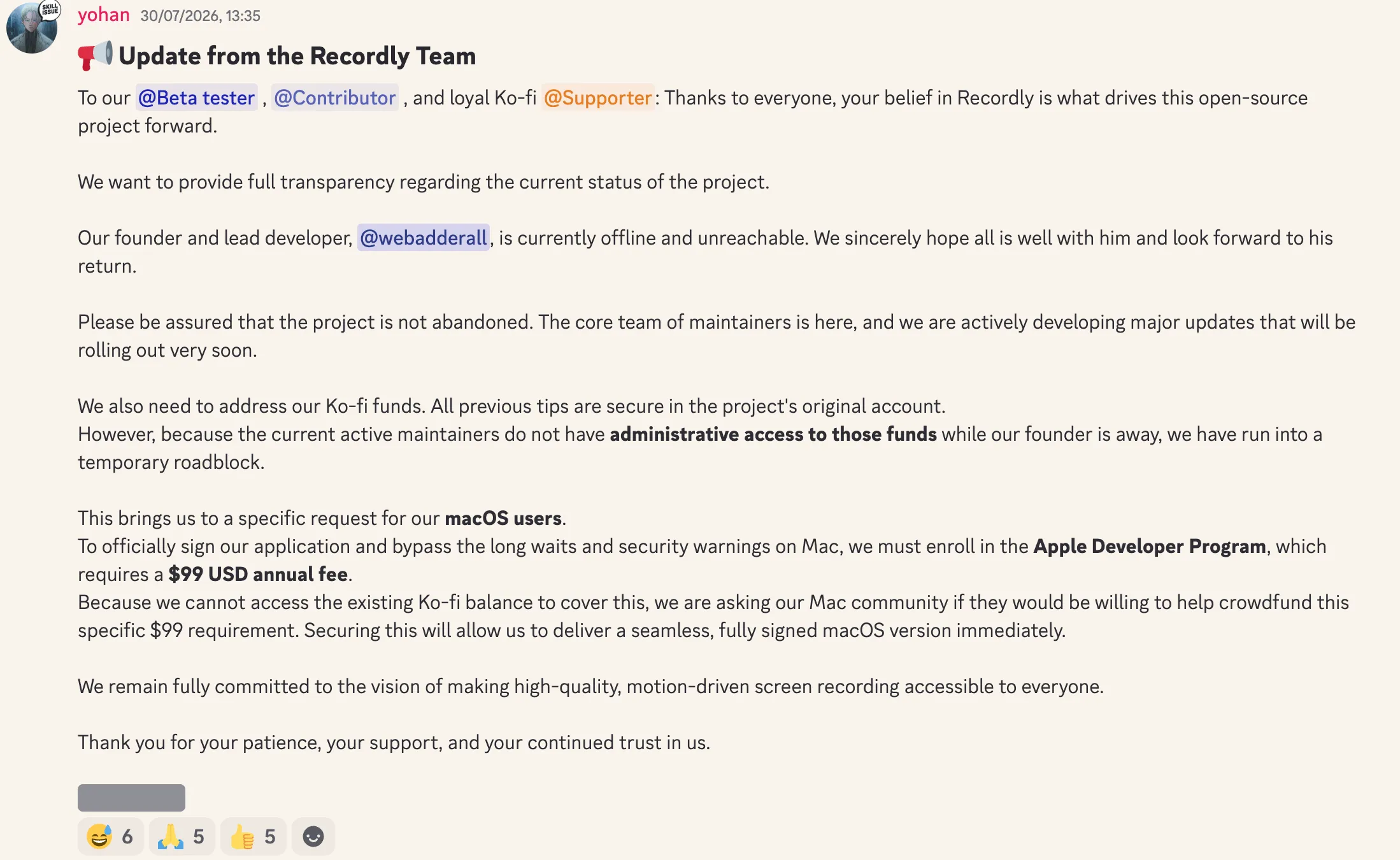
Official Update from Recordly Maintainers:
"Our founder and lead developer, @webadderall, is currently offline and unreachable. We sincerely hope all is well with him and look forward to his return...
We also need to address our Ko-fi funds. All previous tips are secure in the project's original account. However, because the current active maintainers do not have administrative access to those funds while our founder is away, we have run into a temporary roadblock.
This brings us to a specific request for our macOS users. To officially sign our application and bypass the long waits and security warnings on Mac, we must enroll in the Apple Developer Program, which requires a $99 USD annual fee. Because we cannot access the existing Ko-fi balance to cover this, we are asking our Mac community if they would be willing to help crowdfund this specific $99 requirement."
Over a month later in September 2026, here is where the project stands:
- Unsigned, untrusted macOS builds. Without an active Apple Developer Program subscription, Recordly cannot notarize its binaries. Every Mac user attempting to install it must intentionally weaken their system's security settings or run terminal commands to bypass Gatekeeper.
- Founder disappearance and locked project assets. The solo creator holds exclusive administrative rights to the project's donation accounts, domain records, and publishing keys. The volunteer maintainers left behind have zero access to existing contributor funds.
- Pervasive export failures and unreviewed code. Built largely through accelerated "vibe coding" without automated testing suites or structured code reviews, Recordly's GitHub repository is choked with open issues: broken MP4 exports, memory leaks that crash the Electron wrapper, missing audio tracks, and erratic cursor interpolation.
Why You Cannot Trust Critical Software to "Just Anyone"
There is an uncomfortable truth that many developers and creators overlook: screen recording software is one of the most privileged, high-risk tools on your operating system.
To capture your screen, Recordly requires:
- Screen Recording permissions: the ability to inspect, read, and capture every pixel rendered on your displays.
- Accessibility permissions: the ability to intercept global mouse events, cursor movements, and keystroke events.
- System Audio capture: the ability to listen to all audio output across your applications.
Think about what appears on your screen during a normal workday:
- Customer personal data, Stripe revenue dashboards, and banking portals.
- Proprietary source code, GitHub pull requests, and unreleased product roadmaps.
- Private Slack messages, 1Password credentials, and confidential executive emails.
When you install a screen recorder, you are handing that software complete visual access to your company's intellectual property and your personal life.
Can you genuinely justify granting system-wide visual and keyboard monitoring rights to an unsigned binary assembled by an anonymous developer who has vanished, leaving a project whose maintainers are begging in Discord to cover the developer fee?
In software security and operational governance, this is called a Bus Factor of 1 combined with an untrusted supply chain. When an unmaintained project relies on a sprawl of unvetted third-party npm packages, a single compromised dependency or rogue contributor pull request can silently transform an unsigned screen recorder into an active surveillance tool.
Professional work demands professional accountability. You wouldn't run your company's accounting on an untrusted, unnotarized script downloaded from a random forum. You shouldn't trust your screen recording to one either.
The Top Alternative: ScreenKite (Native macOS)
ScreenKite is the primary migration destination for professionals leaving Recordly.
ScreenKite is fully enrolled in the Apple Developer Program, cryptographically code-signed, and notarized by Apple. It launches cleanly on macOS without Gatekeeper friction, terminal bypasses, or security warnings.
Beyond Recording: A Complete Studio Editor
Recordly attempted to mimic Screen Studio's auto-zoom, but offered no true post-production editing capabilities. If you stumbled during a sentence or needed to rearrange clips, you were forced to export your raw capture into DaVinci Resolve or Final Cut Pro.
ScreenKite eliminates the multi-tool tax by integrating a professional video editor directly into the recorder:
- Transcription-based cuts. ScreenKite transcribes your audio locally on Apple Silicon. Delete an awkward phrase or filler word from the text transcript, and the underlying video and audio segments are trimmed automatically.
- Agent editing. Use natural language prompts with Claude Code, ChatGPT Codex, Antigravity, Grok Build, or Kimi to automate cuts, add zoom highlights, generate captions, or adjust framing without tedious manual keyframing.
- Strict local privacy. Your recordings stay on your Mac. There are no background daemons, no silent cloud uploads, and no analytics harvesting your desktop layout. When you quit ScreenKite, it stops completely.
- One-time purchase. ScreenKite is a transparently priced paid tool with a one-time purchase. No recurring monthly subscriptions, no seat fees, and no artificial export limits.
Any downsides? The only downside is there's almost no downside. We're video creators ourselves, so we know exactly what you need.
ScreenKite runs natively on macOS and ships a native Windows Beta. Creators and teams choose it for fast local exports and timeline editing with the AI agent they already use: Claude Code, ChatGPT Codex, Antigravity, Grok Build or Kimi. Describe the cut, and the agent does the trims.
Other Open-Source Alternatives & Why They Fall Short
If your organization strictly mandates open-source software, several other projects exist, but each comes with clear operational compromises:
1. Cap.so (Minimalist Open Source)
Cap.so is an open-source screen recorder designed for lightweight web and desktop recording.
- The Pros: Active repository, modern interface, and simpler codebase than Recordly.
- The Trade-offs: Cap.so focuses primarily on developer experimentation rather than production screencasts. It lacks automatic cursor zoom, transcription-based video editing, hardware-accelerated rendering, and granular timeline post-production. It works for quick bug repros, but falls short for polished customer demos.
2. OpenScreen (Open-Source Electron)
OpenScreen is another GitHub-hosted open-source recorder aimed at capturing desktop activity without subscriptions.
- The Pros: Fully accessible source code, zero license cost, cross-platform ambitions.
- The Trade-offs: Built entirely on Electron, OpenScreen suffers from significant memory bloat and high CPU overhead during high-resolution recording. It lacks intelligent cursor physics, meaning mouse movements appear erratic rather than smoothed. Furthermore, exports are unaccelerated, leading to sluggish render times on 4K multi-monitor setups.
3. OBS Studio (The Heavyweight Broadcaster)
OBS Studio is the gold standard of open-source streaming and recording software, backed by an established foundation.
- The Pros: Rock-solid stability, zero security compromises, immense plugin ecosystem, and zero cost.
- The Trade-offs: OBS is designed for live broadcasting and scene switching, not product demos. It has no automated cursor tracking, no dynamic auto-zoom, and no timeline editing. To achieve a Screen Studio-like presentation in OBS requires third-party Python scripts, manual pan/crop filters, and tedious keyframe management.
Comprehensive Comparison Matrix
| Capability / Metric | ScreenKite | Recordly (Sept 2026) | Cap.so | OpenScreen |
|---|---|---|---|---|
| macOS Security | Apple Signed & Notarized | Unsigned (Gatekeeper Blocked) | Signed / Web-based | Mixed / Developer Signed |
| Project Backing | Dedicated Commercial Engineering | Paralyzed (Founder MIA, Locked Funds) | Active Developer Sandbox | Small Community |
| Engine Architecture | Native GPU | Electron + Unoptimized Node | Web / Hybrid | Electron Shell |
| Auto-Zoom & Smoothing | Yes (Hardware Accelerated) | Yes (Unstable, Crash-Prone) | No | No |
| Transcription Video Cut | Yes (Local Neural Engine) | No | No | No |
| AI Agent Editing | Yes (Claude Code / Codex / Antigravity / Grok Build / Kimi) | No | No | No |
| Full Timeline Editor | Yes (Integrated FCP/CapCut-class) | No | No | No |
| Export Performance | faster in our tests | Unreliable / Failed Renders | Standard CPU | Standard / Sluggish 4K |
| Pricing Model | One-time purchase | Crowdfunding to cover Apple developer cert | Free / Cloud Tiers | Free (AGPL) |
| Background Daemons | None (Quits completely) | None | None | Electron Helpers |
Also read
- ScreenKite vs Recordly: Native macOS Recorder vs Open-Source Alternative
- ScreenKite vs ScreenCharm: Why Native Beats Electron for Screen Recording
- ScreenKite vs OpenScreen: Native macOS Recorder vs Open-Source Electron App
- ScreenKite vs Kap: Native Recorder vs Open-Source GIF Tool
- Native vs Electron Screen Recorders: Performance, Battery, and Why It Matters
- Best Recordly Alternatives in August 2026: Why Users Are Switching
Conclusion
Recordly's collapse illustrates the inherent danger of relying on hobbyist, unmaintained software for mission-critical work. When a tool requires deep operating system access to observe your entire screen and keyboard, trusting an unsigned binary whose sole author has vanished is an unacceptable risk.
Your product demos and tutorials represent your company's craft. They deserve software that opens without security warnings, never crashes during export, and respects your privacy.
With Apple code-signing, hardware acceleration, automatic zoom, transcription-based cutting, and integrated timeline editing, ScreenKite is the reliable, professional solution for Mac creators.
Download ScreenKite for Mac → · Explore ScreenKite Enterprise →
Founder of ScreenKite. Mike records product demos and lessons on a Mac, and builds the recorder and editor he wanted for that work.
www.screenkite.comRelated articles
Recordly Stars vs Maturity: Why Screen Recording Needs a Serious Product
Recordly has about 28.5k GitHub stars, but public maintainer posts and a thick issue backlog show school interruptions and export, audio, and permission failures. Stars are not maturity. ScreenKite is the native Mac product for demos that ship.
ScreenKite vs Recordly: Native macOS Recorder vs Open-Source Cross-Platform Alternative
Comparing ScreenKite and Recordly in September 2026.
Best Recordly Alternatives in August 2026: Why Users Are Switching
Recordly is facing maintenance lockouts and unsigned Mac builds in August 2026. Here is why users are switching to ScreenKite and how the alternatives compare.